The specialist's guide
Solid Surface Worktops, Explained
Everything people ask us about solid surface, answered plainly by the team that fabricates and fits it every day.
Solid surface sits in a sweet spot among worktop materials: shaped like timber, seamless like nothing else, hygienic like glass and repairable like no stone. This guide answers the questions we hear most from Cambridge kitchens and commercial fit-outs alike. If your question is not here, ask us directly and you will get a straight answer.
We fabricate and fit the three leading solid surface brands: Corian, Durasein and Velstone, alongside quartz and granite for projects that suit them better.
FAQs
Frequently asked questions
Straight answers to the things we get asked most. If your question isn’t covered here, we’re a phone call away.
Solid surface is a man-made worktop material, a blend of acrylic resin and natural minerals, supplied in sheets and fabricated into finished surfaces. Because it is the same material all the way through, it can be cut, shaped, thermoformed into curves and joined with adhesives that set to the same composition, which is why the joints disappear.
Typically around one third acrylic or polyester resin and two thirds natural minerals, mainly aluminium trihydrate, plus pigments. Brands such as Corian, Durasein and Velstone vary the recipe and the decors, but the principle is the same throughout the sheet.
Briefly warm is fine, but hot pans straight off the hob should go on a trivet. Solid surface tolerates everyday warmth without trouble, and if someone does scorch it, the burn can usually be sanded out invisibly, which is not true of laminate or quartz.
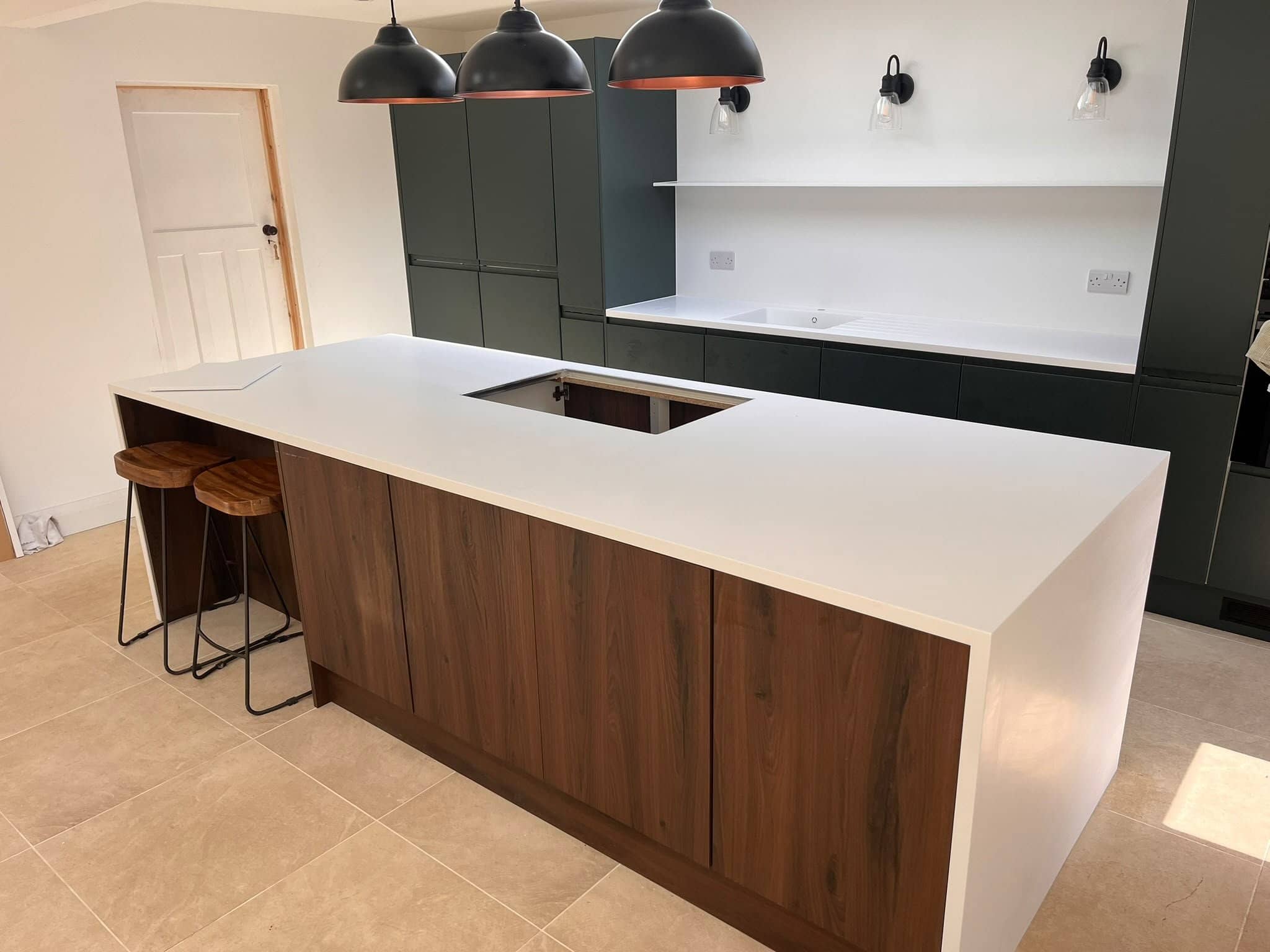
With a colour-matched two-part adhesive, clamped, cured and sanded flush. Done properly the joint is structurally solid and visually invisible, letting long runs, L-shapes and waterfall ends read as one continuous piece.
The surface is non-porous, so it does not stain the way stone or wood can, and spills wipe off. Fine scratches appear with use, as on any worktop, but unlike most materials they can be sanded and polished out, restoring the original finish even years later.
Quartz is harder and more heat-tolerant; solid surface is seamless, warmer to touch, repairable in place and can integrate sinks and upstands invisibly. For hygiene-critical or heavily shaped designs solid surface usually wins; for a stone look with maximum scratch resistance quartz has the edge. We fit both and will tell you straight which suits your room.
Broadly comparable to mid-range quartz: more than laminate, usually less than premium natural stone. Price depends on the brand, the colour and the amount of shaping, sinks and detail. A templated survey gives you an exact figure; quotes are free and without obligation.
CCS Surfaces. We are solid surface specialists based at West Wratting, Cambridge, part of the DuPont fitters quality network, fabricating and installing Corian, Durasein and Velstone across Cambridgeshire, Suffolk, Essex and beyond.
Download our free brochure
Materials, finishes and recent projects: everything you need to plan your surfaces, in one place.